There's no shortage of career advice online: quizzes, templates, videos and apps. They can be useful. But research on how career support is delivered suggests that talking to a real person makes a bigger difference.
Comparing the options
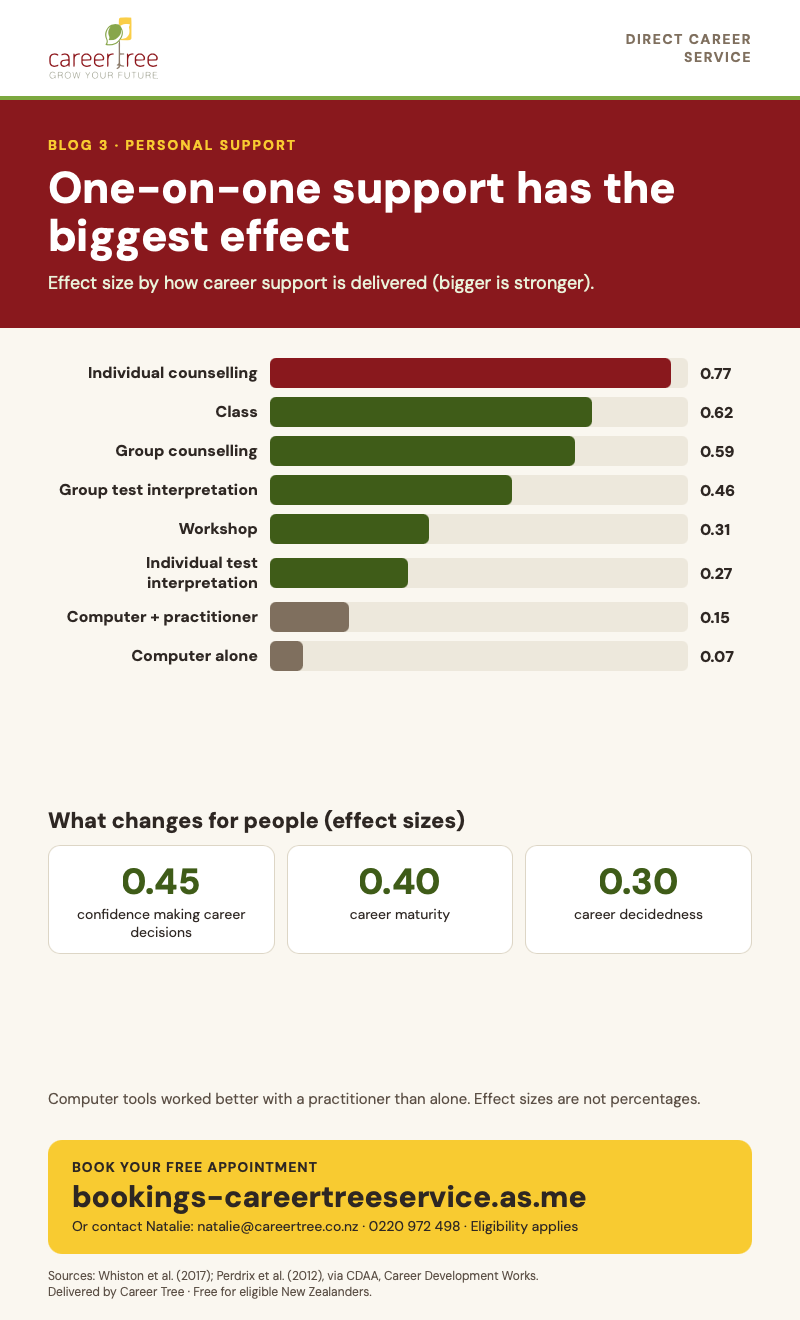
The CDAA report draws on research that compared different ways of delivering career support, using a measure called effect size. A bigger number means a bigger effect. Here are some of the results:
Individual counselling: 0.771 (large)
Class: 0.619 (large)
Group counselling: 0.586 (large)
Group test interpretation: 0.464 (large)
Workshop: 0.307 (large)
Individual test interpretation: 0.265 (typical)
Computer plus practitioner: 0.149 (small)
Computer alone: 0.067 (small)
Individual counselling showed the largest effect, and computer-based support on its own had the smallest. Importantly, the effect of computer-based tools was bigger when a practitioner was involved than when people used them alone.
Why the relationship matters
The report also notes that the working partnership between practitioner and client is an important part of why personalised support works. A practitioner can listen, ask the right questions, help you make sense of assessments and adapt to your situation in a way that a website can't.
What changes for people
The research on career counselling also looks at changes in the factors that shape career decisions. In one large review, effect sizes were in the "large" range for career maturity (0.40), career decidedness (0.30) and career decision-making self-efficacy, meaning confidence in making decisions (0.45). The CDAA report also points to research showing that career counselling can have long-term positive effects, including a one-year follow-up study.
Group or one-on-one?
Group work also showed large effects, so both can work well. At Career Tree, the Direct Career Service is one-on-one: you meet your career practitioner in person at a Work and Income site, by phone or online through Zoom.
Try a conversation
Book your free appointment at bookings-careertreeservice.as.me (eligibility applies).
Sources: Whiston, S. C., et al. (2017), Journal of Vocational Behavior, 100, 175-184; Perdrix, S., et al. (2012), Journal of Vocational Behavior, 80(2), 565-578; both as summarised in CDAA, Career Development Works. Effect size labels use the Gignac and Szodorai model.